The global ski goggles market, valued at $1.28 billion in 2023 and projected to grow at a CAGR of 5.2% by 2030 (Allied Market Research), is undergoing a paradigm shift driven by technological advancements and evolving consumer expectations.
Industry Overview: Growth Drivers and Regional Shifts
The ski goggles market's expansion is fueled by two primary forces:
Geographic Disparities:
- Europe (35% market share): Dominated by the Alpine region, where consumers prioritize premium optics and anti-fog durability.
- Asia-Pacific (8.1% CAGR): China and Japan lead in mid-range goggles, with brands like NAN and Vector capitalizing on the region's growing winter sports participation.
Consumer Demand Evolution:
- Functional to Vision-Centric: Beyond basic impact resistance, skiers now demand variable light transmission for low-light conditions and anti-glare coatings for high-altitude snowfields.
Technical Excellence: Cylindrical Lens Design and Anti-Fog Mechanisms
Optical Superiority of Cylindrical Lenses
Unlike traditional flat lenses, cylindrical designs feature a vertical curvature that minimizes distortion while maintaining horizontal flatness. Key advantages include:
- 20% Wider Field of View: Reduces "tunnel vision" common in flat lenses, enhancing peripheral awareness during high-speed descents.
- Cost Efficiency: Manufacturing costs are 30% lower than spherical lenses (which curve both vertically and horizontally), making cylindrical goggles the mid-market sweet spot.
Anti-Fog Technology Matrix
Modern anti-fog systems integrate multiple layers of innovation:
Dual-Layer Lens Construction:
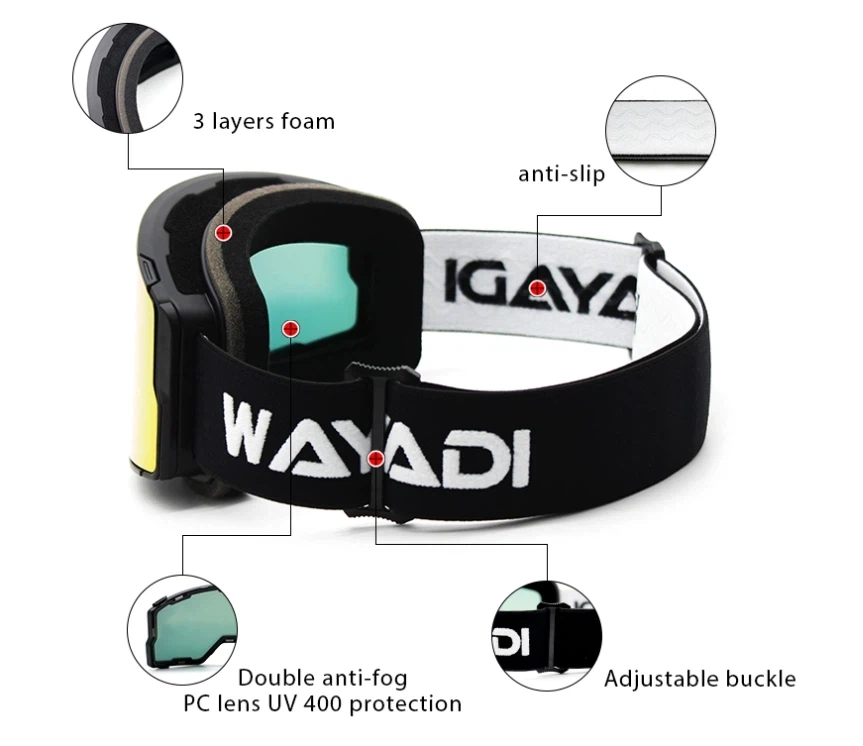
A thermoplastic polyurethane (TPU) membrane separates two lenses, creating an insulated air gap.
A hydrophilic anti-fog gel fills this gap, lowering the dew point and preventing condensation across a -30°C to +10°C temperature range.
Ventilation Engineering:
- Front Intake Vents: Direct cold airflow to the inner lens surface, accelerating evaporation.
- Rear Exhaust Ports: Equipped with one-way valves to expel humid air without compromising wind resistance. This system boosts air circulation efficiency by 40% compared to single-layer goggles.
Performance in Extreme Environments: From Alpine Peaks to Humid Slopes
High-Altitude Adaptability
At elevations above 2,500 meters, UV radiation intensifies by 10-12% per 1,000 meters (WHO). Cylindrical lens goggles counter this through:
- UV400 Protection: Blocks 99.9% of UVA/UVB rays, reducing snow blindness risk.
- Photochromic Lenses: Adjust VLT from 15% (bright sun) to 75% (overcast) in <30 seconds, eliminating the need for lens swaps.
Humidity and Ice Resistance
In coastal or spring skiing conditions (e.g., Japan's Hokkaido resorts), moisture management is critical:
Superhydrophobic Coatings: A nanoscale silica-based layer on the outer lens achieves a water contact angle >110°, causing droplets to roll off instead of freezing.
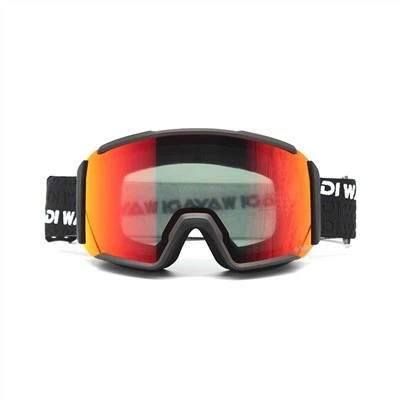
By merging optical precision, adaptive materials, and user-centric design, brands are not only meeting but anticipating the demands of modern skiers. As winter sports grow more inclusive and environments more unpredictable, the goggles that thrive will be those that seamlessly integrate science with the thrill of the descent.