The cylindrical lens thing - it's not what most people think
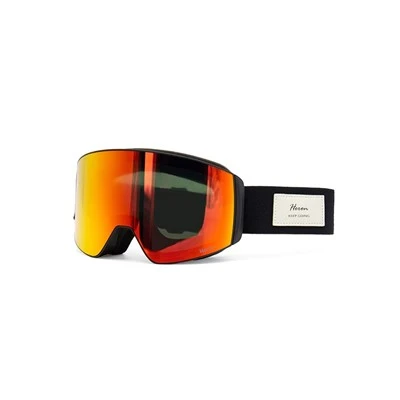
There's a common assumption in the ski industry that spherical lenses are automatically "premium" and cylindrical lenses are the budget option. After manufacturing both types for years, I'd say that oversimplification misses the point. A cylindrical lens curves horizontally across your face but stays flat vertically - and yes, it's less expensive to produce. But here's what the marketing doesn't always tell you: some pros actually prefer cylindrical lenses because the flat vertical profile provides more frame flexibility and a closer, more adaptive fit around the face. They also tend to sit slimmer on the face, which matters if you're pairing them with a helmet. Our 18.2cm-wide cylindrical model, for instance, uses the horizontal curve to eliminate the kind of peripheral distortion that messes with depth perception on variable snow. Is a spherical lens optically purer on paper? Sure. But in real skiing conditions - changing light, speed, terrain - the difference isn't always as dramatic as the price gap suggests.
Anti-fog isn't one thing - it's three things working together
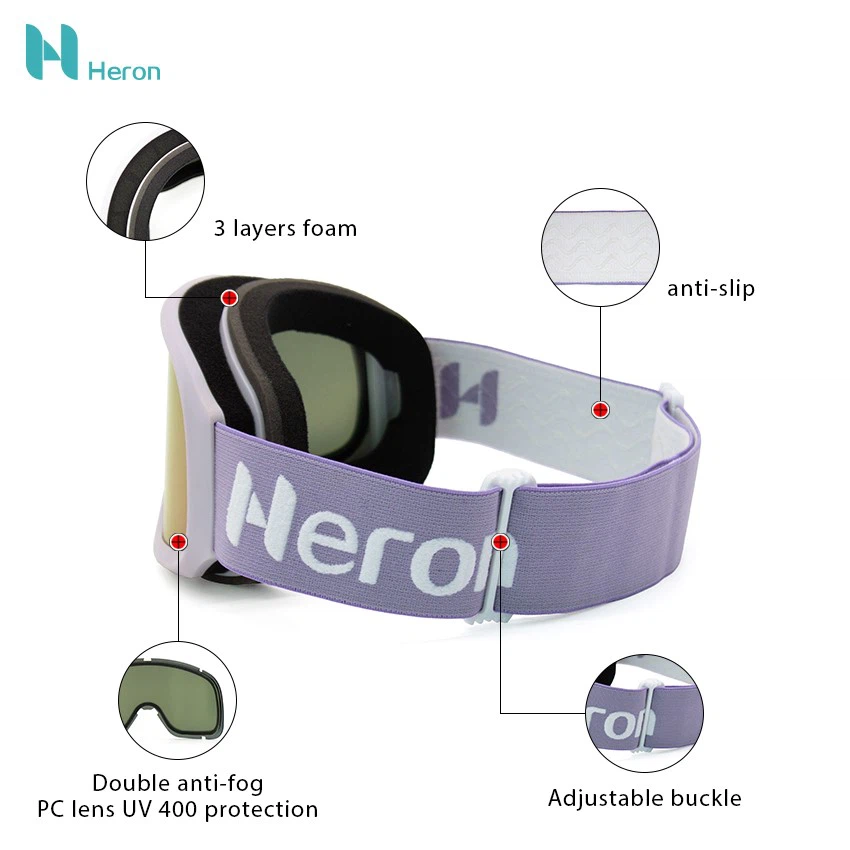
If I had a dollar for every customer who asked for "just a better anti-fog coating," I'd have a very comfortable retirement. The reality is that fog resistance in a ski goggle is a system, not a single feature. It typically comes down to three layers working in parallel: a thermal barrier created by the double-lens construction (the air trapped between the inner and outer lens acts as insulation), a chemical anti-fog treatment applied to the inner lens surface, and frame ventilation that moves moisture out before it condenses. When one of these three fails, the whole system fails. We see this all the time with goggles that come back - it's rarely a single point of failure. Maybe the ventilation channels got blocked by a poorly fitting helmet. Maybe the inner lens coating got wiped too aggressively and degraded. Maybe the double-lens seal was compromised during manufacturing. On our current model, we run a dual anti-fog coating plus two-way ventilation that keeps air moving even when the skier is wearing a face mask - which, let's be honest, has become a lot more common in recent years.
What actually causes fog - and what doesn't help
Here's something a lot of skiers don't realize: most fogging problems aren't caused by the goggle at all. They're caused by heat and moisture rising from the skier's own face, especially when a neck gaiter or face mask is tucked under the goggle frame and directing warm breath straight up into the lens cavity. A goggle with proper ventilation can handle normal perspiration, but if you're trapping exhaled moisture inside the frame, no coating in the world is going to save you. We recommend to our wholesale buyers that they educate their customers on this - a goggle that fits well over the nose and doesn't gap, combined with a mask worn over rather than under the frame edge, makes a bigger difference than most people think.
Coatings that actually last - or don't
The anti-fog inner lens on most mid-range and high-end goggles is made from cellulose acetate (CA), which has a natural affinity for anti-fog treatments - the coating bonds better and lasts longer than it would on straight polycarbonate. Higher-end goggles increasingly add hydrophobic and oleophobic outer lens coatings to repel water, oil, and grime. These outer coatings are nice to have, but they're secondary - if the inner anti-fog layer fails, a water-repellent outer lens won't save your visibility. From a manufacturer's perspective, the quality difference between a cheap anti-fog dip and a proper multi-layer treatment is massive, but it's completely invisible to the naked eye at point of sale. That's the kind of thing where brand reputation and honest spec sheets actually matter.
Things worth checking before you place an order
If you're sourcing goggles for a brand or retail channel, a few questions can save you a lot of headaches later. First, ask what certification standard the goggles meet - EN 174 (Europe) and ASTM F659 (US) are the two big ones, and they cover optical quality, impact resistance, and field of vision. If a factory can't name the standard, that's a red flag. Second, ask about the anti-fog coating's durability - not just that it exists, but how many wet-dry cycles or wipe-downs it's tested to survive. Third, check whether the manufacturer offers OTG (over-the-glasses) compatibility - the model we referenced above accommodates most prescription frames without pinching. This is a feature that's easy to overlook but opens up a significant segment of buyers who otherwise can't ski comfortably. And finally, look at customization depth - can they do custom lens tints, strap logos, frame colors? Our standard lead time runs around 25–35 days depending on volume, but custom work adds value for brands trying to differentiate. A goggle that fits the face well, handles real moisture conditions, and actually holds up over multiple seasons - that's still rarer than it should be.